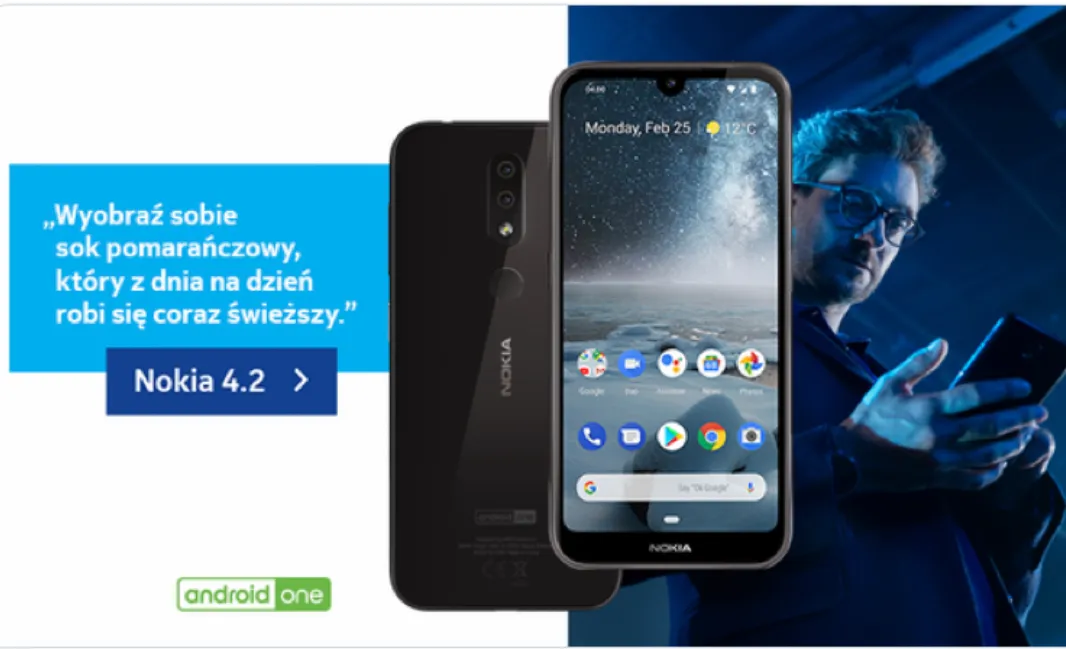
There is a very good chance you once owned a Nokia. I owned several. Nothing special about that: all it took was being over 30 and growing up somewhere with mobile phones. Nokias were simple to use and practically indestructible. It could have stayed that way, if the Finns hadn’t gone into hibernation exactly when smartphones appeared on the horizon.
From world leader, Nokia turned into leftovers that someone kept reheating. In 2019 the reheating was done with ads so strange that I decided to take them apart. Along the way it turned out that behind the absurd slogans stood a perfectly sensible promise, one nobody managed to explain in plain words. That is the whole lesson of this story: a good product can lose to its own advertising.
Where is Nokia from, and what happened to it?
Nokia is a Finnish company headquartered in Espoo, in the Helsinki metropolitan area. According to Wikipedia, the mining engineer Fredrik Idestam founded it in 1865 as a pulp mill. The name comes from the town of Nokia, where the company opened its second mill. It was a long way from paper to phones, but the Finns made it.
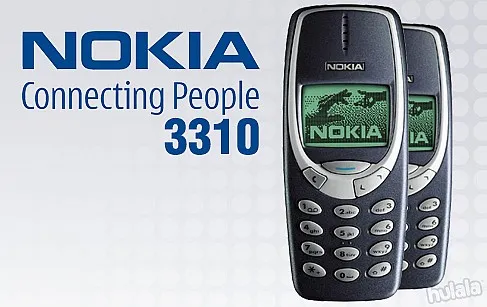
Between 1998 and 2012 Nokia was the world’s largest mobile phone maker. It invested its money, however, in technology that lost to the iPhone and Android, above all the Symbian operating system. In February 2011 the then CEO, Stephen Elop, announced a partnership with Microsoft. Nokia abandoned Symbian for Windows Phone, which ended even worse.
Microsoft bought Nokia’s phone business for about €5.44 billion. The deal closed in April 2014, and as early as July 2015 Microsoft wrote down $7.6 billion on the purchase and announced up to 7,800 job cuts. In 2016 it sold the feature phone business to the Finnish company HMD Global and Taiwan’s FIH Mobile for $350 million.
I have to correct a simplification I used to repeat myself. HMD did not “buy Nokia back from Microsoft.” Nokia the company never disappeared: today it makes network equipment, bought Alcatel-Lucent in 2016 and licenses its brand. HMD, run by people with a Nokia past, got the right to put the logo on phones.
HMD promised to rebuild the legend. My impression was that the plan was closer to selling “anything with Android and a Nokia logo.” I didn’t hold that against them; plenty of companies do the same. What I did have a problem with was the advertising. In mid-2019 it kept appearing in my Facebook and Twitter feeds, and I couldn’t stop marveling at it.
Orange juice that gets fresher every day
The lines below come from HMD’s campaign in Poland, where I kept running into them. The translations are mine. I could find no trace of these particular slogans in English, although HMD pushed the same idea that spring in an English-language video arguing that Nokia phones get better with time.
Let’s start with the last one I came across back then: “Imagine orange juice that gets fresher every day.” My first thought: what are they drinking at Nokia? Or at the agency? As a programmer, I know what they meant. But I don’t believe the average person looking for a cheaper alternative to Samsung understood any of it. My impression is that someone came up with the punchline before deciding what the joke was about.
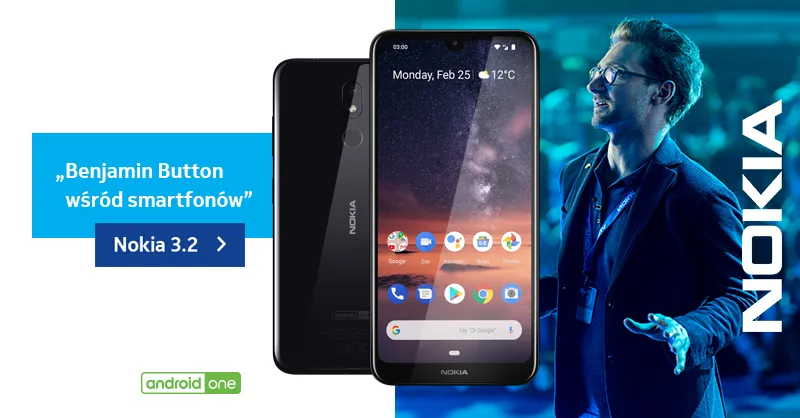
The next hit compared the Nokia 3.2 to Benjamin Button, the hero of the film The Curious Case of Benjamin Button, who grows younger as he ages. So this Nokia will regress until I’m left with a handful of sand, silicon and plastic in my pocket?
Another ad claimed: “After three years of use it is three years younger, not three years older.” It sounds intriguing, but I have my doubts. New versions of Android are usually more demanding, so a cheap phone doesn’t tend to speed up after three years of updates.
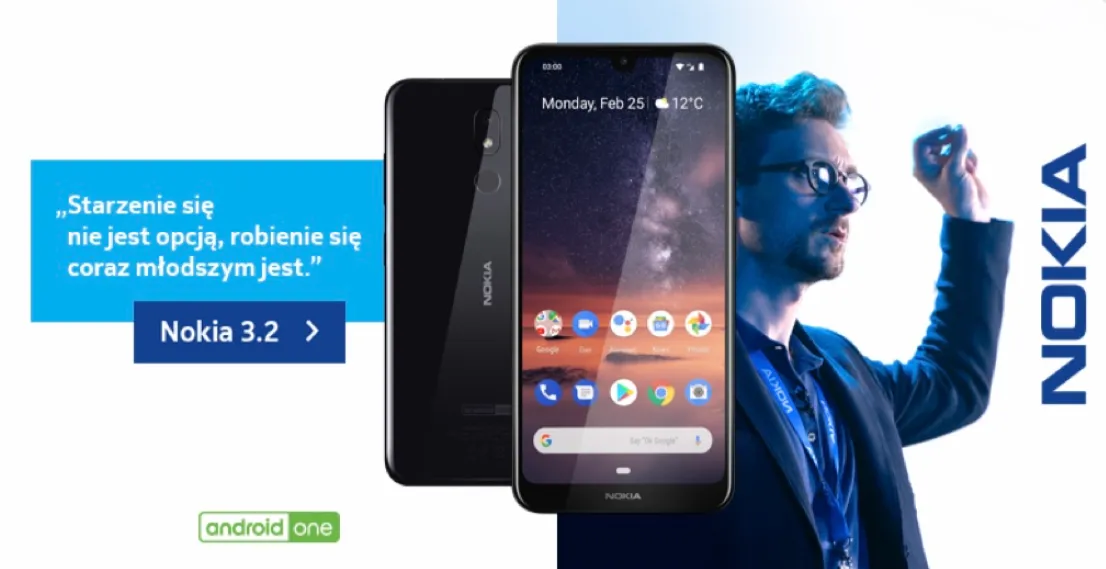
“Aging is not an option, getting younger is.” A lovely vision. I would gladly apply the technology to my own beard, which goes gray faster than my phone gets updates. For dessert, the marketing squadron took on the world of fashion: “It’s like being always in style without ever getting older.” So Nokia also solved the problem of fashion going out of date.
What was it all about? Android One and software updates
Behind the juicy metaphors stood one concrete fact. The Nokia 4.2 and 3.2 belonged to Android One, a Google program that ran from 2014 to 2023. Android One phones were guaranteed at least two years of operating system updates and three years of security patches. In the world of cheap phones, which often didn’t get a single major update, that was a real advantage.
Then came a coincidence. In May 2019 the US put Huawei on its Entity List. That meant new Huawei phones could no longer ship with Google’s apps and services, including the Play Store. Customers started wondering whether their phone would get any update at all a year from now. In my view Nokia’s marketing hit that moment perfectly with its topic and terribly with its execution.
On the product itself, I have to give the Finns their due. According to a Counterpoint Research ranking cited on Wikipedia, in August 2019 Nokia led the global rankings for updating software and security among Android makers other than Google. The promise was real. The problem was that nobody understood it.
Why didn’t the Nokia ads work?
An ad in a social media feed gets very little time before the thumb scrolls on. Facebook’s own research from 2016 found that people spent, on average, 1.7 seconds with a piece of content in the mobile News Feed. In that time the juice line demands three steps. First you have to work out that “fresher juice” means a phone that doesn’t age. Then that it doesn’t age because it gets updates. Finally, that updates mean security and new features. Most people drop out at step one.
Economists named this the curse of knowledge in 1989, and psychologists have been demonstrating it ever since. Once you know something, it is hard to imagine how it looks to someone who doesn’t. In a famous 1990 experiment at Stanford, Elizabeth Newton asked people to tap out the rhythm of well-known songs and predict how many listeners would name them. The tappers expected about half. The listeners got 3 out of 120, or 2.5% (Harvard Business Review). The tappers could hear the melody in their heads; the listeners heard only knocking on a table.
The agency people were the tappers. They had probably been living with the topic of updates for months, so the metaphor seemed obvious to them. The audience heard only the knocking: juice, a bearded man in glasses and a phone. This is exactly the kind of mistake that a few minutes of market research catches. Show the juice line to five people outside the building and ask them what is being sold.
It would have been enough to say plainly what the customer gets, for example: “In three years this phone will still be getting security fixes. Google guarantees it.” Less creative, but understood in a second, and during the Huawei affair it would have hit a real customer fear.
I clicked. Nokia didn’t want to sell me anything
Out of pure curiosity, I clicked one of those ads. To my surprise, Nokia didn’t want to sell me a phone at all. The main button on the page I landed on said “Sign up.”
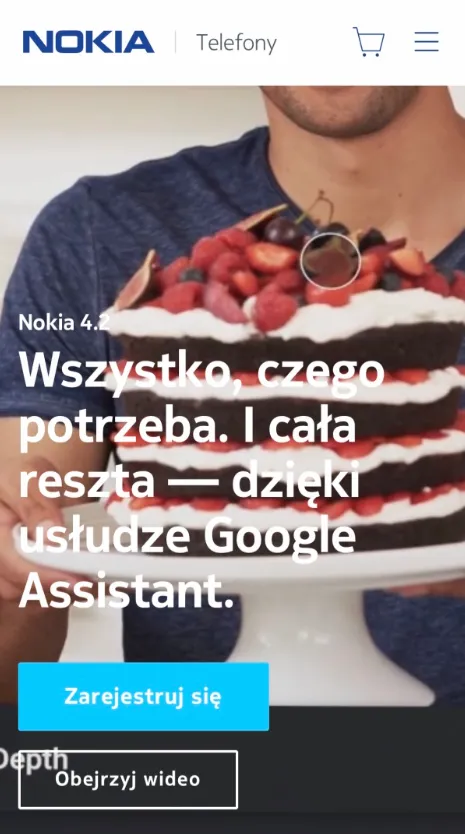
The ad promised fresh juice, the page showed a cake and the Google Assistant, and at the end it asked me to register. Each element told a different story. Marketers call the fix “message match”: the page you land on should continue the sentence the ad started. I suspect someone was given a budget for a brand campaign and badly wanted to do something creative. Nobody asked what the customer was supposed to do after clicking. A sign-up form is a request for participation, and participation is not engagement, let alone a sale.
What has changed since 2019?
I first wrote about these ads in July 2019. Since then the story has come full circle in an interesting way.
The fortunes of HMD and the Nokia brand, according to Wikipedia:
- In 2022 HMD sold 40 million devices, down from 56 million a year earlier, with revenue of €1.2 billion and a net loss of about €77 million.
- In 2024 the company started selling smartphones under its own HMD brand. In April 2024 it also brought back a refreshed Nokia 3210, keypad included, of course.
- By 2025 HMD had discontinued Nokia-branded smartphones. Only feature phones kept the brand, and in September 2025 the license was extended by two to three years beyond its original 2026 expiry.
- In September 2025 HMD pulled out of the US market, citing unfavorable regulatory conditions, with new tariffs a major factor.
The most interesting part, though, is what happened to the promise of long updates. Google announced seven years of OS and security updates for the Pixel 8 (2023), and Samsung promised seven generations of OS upgrades and seven years of security updates for the Galaxy S24 series (2024). The European Union went further. Under Regulation 2023/1670, since June 20, 2025, makers of smartphones sold in the EU must provide operating system updates for at least five years after a model stops being placed on the market.
So in 2019 Nokia was advertising something that a few years later became the industry standard, and then a legal requirement. Nokia smartphones, however, no longer exist.
My take
I have an odd relationship with Nokia. When I first wrote about these ads, almost every one of them knocked me off my chair and left me scratching my head, and I’m still grateful for that. In hindsight, though, I can see the Finns were right about the subject. A phone that keeps getting updates for years is exactly what customers need. Long software support has been one of the main arguments for the iPhone for years.
They lost on the message. A good product with an ad you have to decode loses to an average product that says clearly what it does for you. Companies relearn this lesson over and over, usually after the budget is spent. If you want the opposite, a piece of cleverness that hit exactly what it was aimed at, read the story of Citroën, Boulanger and the oil dipstick sabotage.
Questions people ask
Where is Nokia from?
Nokia is a Finnish company headquartered in Espoo, in the Helsinki metropolitan area. Fredrik Idestam founded it in 1865 as a pulp mill, and the name comes from the town of Nokia, where the company’s second mill stood.
Who makes Nokia phones now?
Since 2016 Nokia-branded phones have been sold under license by the Finnish company HMD Global. By 2025 HMD had dropped Nokia smartphones and sells smartphones under its own HMD brand; the Nokia name lives on only on feature phones with keypads.
What was Android One?
A Google program that ran from 2014 to 2023 for phones with stock Android. It guaranteed at least two years of operating system updates and three years of security patches.
Why didn’t Nokia’s ‘fresher juice’ ads work?
They asked people to decode a metaphor in the second or two they spend on an ad in a social feed. The real message, guaranteed updates for years, was buried three steps behind the joke.